Media Kit
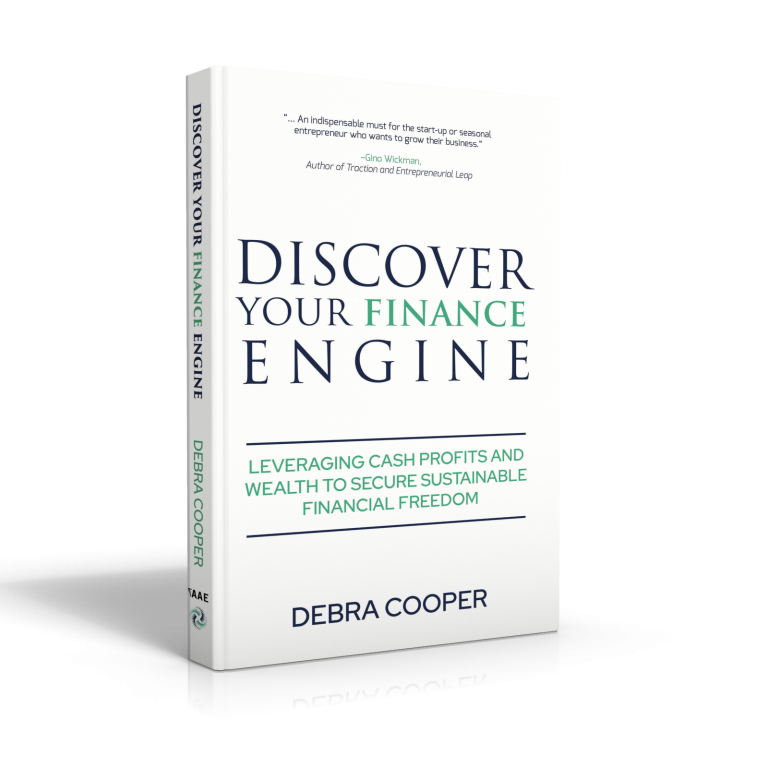
Discover your
Finance Engine
Leveraging Cash Profits and Wealth to Secure Sustainable Financial Freedom
By Debra Cooper
Everything you need to know without having to read the book!
Are your finances out of control? Master your financial destiny. Turn your business into a cash generating, profit making machine and secure your financial freedom.
Ever wondered why you make solid profits but your bank account, has no cash in it? Tired of having to scrounge up cash to meet the payroll or satisfy suppliers chasing payment? Frustrated you are always the last to get paid?
You are not alone.
Many business owners, despite managing a profitable business, live in fear of checking their bank balance. They’re led to believe that profits are enough to keep a business humming. However, financial viability is more than making profits.
DEBRA COOPER is a small business owner, coach and author of,
DISCOVER YOUR FINANCE ENGINE: LEVERAGING CASH PROFITS AND WEALTH TO SECURE SUSTAINABLE FINANCIAL FREEDOM.
Discover Your Finance Engine is the accumulation of experience and knowledge of Small Business financial management that Debra, the author, has gained working alongside business owners in a range of industries. She knows that when small business owners invest in the intellectual knowledge of their business finances, they can understand the key financial numbers of their business in as little as an hour a month.
Discover Your Finance Engine encapsulates a process of understanding the face value of the financial statements your Finance Engine produces and demonstrates how to use that knowledge in day-to-day management of your business.
Debra outlines:
- The What, Who, Why, How and When: As a business owner, you need to understand what constitutes your Finance Engine, who is accountable for it, why it should be maintained, how to maintain it and how often. Once these are adhered to and achieved your Finance Engine will produce three core financial statements that provide more than the results of your business activity. With intuitive understanding they can be the strategic tool that enhances your decision making and facilitates reaching your vision.
- Purpose: The purpose of each of your three core financial statements is outlined, the characteristics are highlighted and the place they each serve in your business’ Finance Engine is explained.
- Elements: The elements of each of your three core financial statements are defined and a detailed discussion is conducted on what the associated figures are reporting. Once you understand how these figures relate to the flow of cash into and out of your entity, the financial statements appear less daunting and a tool of information.
- Calculations: The mathematical equation of each statement is outlined along with the significance of each and how you can benefit from this knowledge and understanding.
- Relationships: A detailed discussion on how each of the elements relate to other elements on the same statement will provide further understanding of how this relates to your profitability, your cash balance and, the equity you hold in your business. Each statement also has a relationship with the other statements and you will discover why only producing the profit and loss statement is not enough to run your business.
- Health Status: The health status of each financial statement is defined and explained in depth so that you can measure where your business is at and identify weaknesses and strengths so the right decisions can be made to strengthen your financial stability.
Case Study
The outline of the Case Study is available in the FREE Sample Chapter download.
An additional feature of Discover Your Finance Engine is the case study which is written in fiction and based upon a fictional landscaping business experiencing cash flows issues. The case study illustrates how to interpret the financial statements and demonstrates how you can use them to improve, not only the financial status of your business, but easily understand where your weaknesses and strengths are. Possible solutions are identified and implemented to improve not only the business’ cash flow but profitability and financial stability.
As business owners, your skillset is focused upon creating and delivering the products, services and solutions to ease the pain and suffering of your clients. Financial management is more often than not a skillset you are missing when you started your small business journey. However, by default, in order to survive long-term, you need to be a financial expert about your business.
The business owner does not need to know how to prepare these financial statements, but must be able to interpret them swiftly and accurately so they can make effective decisions with confidence and not compromise their business financially.
Readers of Discover Your Finance Engine will discover:
- The importance of the three levels of profitability
- How to influence these profitability levels to improve their income and operating cash flow
- The cash liquidity health of their business
- Where cash has become trapped in processes and how to release it so that it lands in their bank account quickly
- The activities that drive the cash flowing into and out of their business
- How much cash their business activity needs to grow and whether this can be financed internally or through external finance
- The full scope of their business finances rather than just how you make a profit.
For additional information and guidance to Discover Your Finance Engine visit …
https://zephyrms.com/library/discover-your-finance-engine/ to access:
- Sample Chapter
About The Author ...
Small Business Management is inherent in Debra’s DNA. Raised in the shadow of a family business and having worked for, and with, small business owners in excess of twenty-five years, Debra has a wealth of knowledge in solving the challenging problems the smaller entity faces.
An author, qualified Certified Practicing Accountant, with a Masters in Business Administration, Debra passionately supports small business owners.

Having observed and absorbed the skill of small business management at a young age, her first small business was a pop-up stand on the street corner, selling excess lemons from the family lemon tree. Recruiting the neighborhood kids to help sort the good lemons from the bad, and then sending her team back to the lemon tree for more when stocks got low! Late afternoon, she would split the profits equally amongst her neighborhood ‘workers’ and together they would head to the Milk Bar to splurge. She was eight years old the first time she turned a profit and it was from those early beginnings that her drive for small business management grew.
Debra lives in Melbourne, Australia with her family.
More information can be found at https://zephyrms.com/.
Chapter Overview
Note to Reader
Introduction
Case Study: Sam’s Dilemma
Part 1: The Heart of Your SME
Elusive Road to Success
The Embodiment: The What
The Controller: The Who
Pulling Back The Skin: The Why
Building Your Empire: The How
No Time Like the Present: The When
Part 2: The Three Platforms to Financial Freedom
Chapter 1: Without Profits, What’s the Point: The Measure of Your Business
Chapter 2: The Ingredients of Profitability: Elements of the P&L
Chapter 3: The Blood of Your Entity: Let’s Keep the Blood of Your Business Pumping!
Chapter 4: Without Stability, What’s the Point: When Revenue Streams Fail, Where are You?
Chapter 5: The Recipe of Stability: Elements of the Balance Sheet
Chapter 6: The Backbone of Your Entity: No Backbone, No Survival
Chapter 7: Without Oxygen, What’s the Point: Cash Makes Your Entity Breathe
Chapter 8: The Ingredients of Oxygen: Elements of the Cash Flow Statement
Chapter 9: The Lifeline of Your Entity: Without Cash Reserves You Die!
Part 3: Fine Tuning Your Finance Engine
Case Study: Sam’s Dilemma Solved
Change Your Financial Destiny
Noteable Quotes
“More businesses fail from financial mismanagement than for any other reason. Not only do aspiring entrepreneurs start their small business journey with insufficient capital, but the management of the capital they generate is often managed poorly. … many viable businesses never get the chance to succeed because there is a lack of focus on the financial flows in and around their businesses. The Finance Engine and the benefits it provides are often undervalued and under utilized, making the road to success unnecessarily challenging, or even impassable.” (page 28)
“… even a cash Profit & Loss Statement does not communicate your SME’s full cash position. A cash P&L will only report the cash profits your business earns from normal operations and not the net cash of all cash receipts and all cash payments.” (page 59)
“The three levels of profit calculations are Gross Profit, Operating Profit and Net Profit. The results and relationships are unique to your business. Understanding their natures and relationships to revenue will put you in a better position to make effective decisions when considering increasing revenue by price or by volume and provide you with an understanding of how many sales units you need to sell to make an overall Net Profit. The calculation of the three profit levels become exceedingly important when assessing your desired level of Net Profit and the strategies you need to implement.” (page 69)
“A business model is the infrastructure of your business and how you produce and deliver your core service and or product. Your business model will play a large part in the financial support you require and the flow of your transactions through your SME, affecting your financial statements.” (page 103)
“For long-term financial survival of your SME, financial stability is more important than profitability alone. When revenue streams fail, it is your SME’s financial strength and depth of resources that will dictate how equipped your business is to survive a financial crisis.” (page 118)
“Equity is often overlooked as being an element that needs to be managed. Some business owners see it as just the balancing element on the Balance Sheet. However, equity, just like your business’ profits, assets and liabilities, should be managed on a progressive basis to ensure you retain a healthy claim over the assets of your business.” (page 155)
“It is critical that what your business pays you is what your business can afford. When you withdraw too much, your business becomes starved of cash. Cash is like oxygen to a business, for without it the wheels of business activity are hindered and chances for growth without extensive borrowing becomes impossible. When starved of cash on a long-term basis, a profitable and healthy business can die.” (page 160)
“The Profit & Loss Statement shows net earnings over a particular period, whereas the Balance Sheet is a statement of net wealth at a point in time. To calculate the wealth of the business, you need to take into account the earnings over the life of the business. The calculation of wealth on the Balance Sheet therefore depends on the Profit & Loss Statement.” (page 169)
“For a true representation of an enterprises’ financial status from an operational and financial position perspective, it is good practice that both the Profit & Loss Statement and Balance Sheet Statement are prepared on a monthly basis. Cash is represented in all elements on both statements and when only one statement is prepared, the full financial picture is not being reported.” (page 170)
“The Cash Flow Statement is designed to separate cash transactions into categories that explain what drives the cash flows in your SME and to help with decisions you make regarding the allocation of cash to particular activities. It will also serve in highlighting bad cash habits detrimental to your SME’s survival.” (page 199)
“Cash is possibly the most important resource in your business, and it should be managed as such. I have always been a big believer that ‘Money pays Respect’. When you manage your cash and the allocation of it with forethought, planning with a level of respect regarding the consequences of where and when you spend it, cash will naturally accumulate in your bank account.” (page 211)
“Every business has a Finance Engine and it should be seen and nurtured by the business owner as an asset and not a burden that must be addressed to satisfy statutory and taxation requirements. You and your wellbeing are the most important reasons to have a well-managed Finance Engine and all it takes is some investment in understanding the flows of finance specific to your business, and how this knowledge can improve your management and shore up the chances of success for your business.” (page 233)
Suggested Interview Questions
- Where does your passion for small business come from?
- What are the three most common challenges facing small business?
- Needless to say that 2020 has been a hard year for small business financially. What can small business be doing to survive?
- How should the small business be managing their finances to achieve financial stability?
- Your book is titled, Discover Your Finance Engine. Can you define what you mean by Finance Engine?
- What will we learn about the financial statements in Discover Your Finance Engine?
- How is Discover Your Finance Engine different from any other book on financial statements?
- Will a small business owner become a financial expert of their business by reading Discover Your Finance Engine?
- What are three tips you would give the small business owner today?
- If someone reads the book do they still need an accountant?
- When do I know that my business is not able to be saved?
- Would the book also give me advice on where to spend my money e.g. – production or marketing?
- For someone that hates and doesn’t understand figures, is the book something that I can easily understand?
- What’s the difference between what a bookkeeper can do and your services?
- Do I need both bookkeeper and accountant?